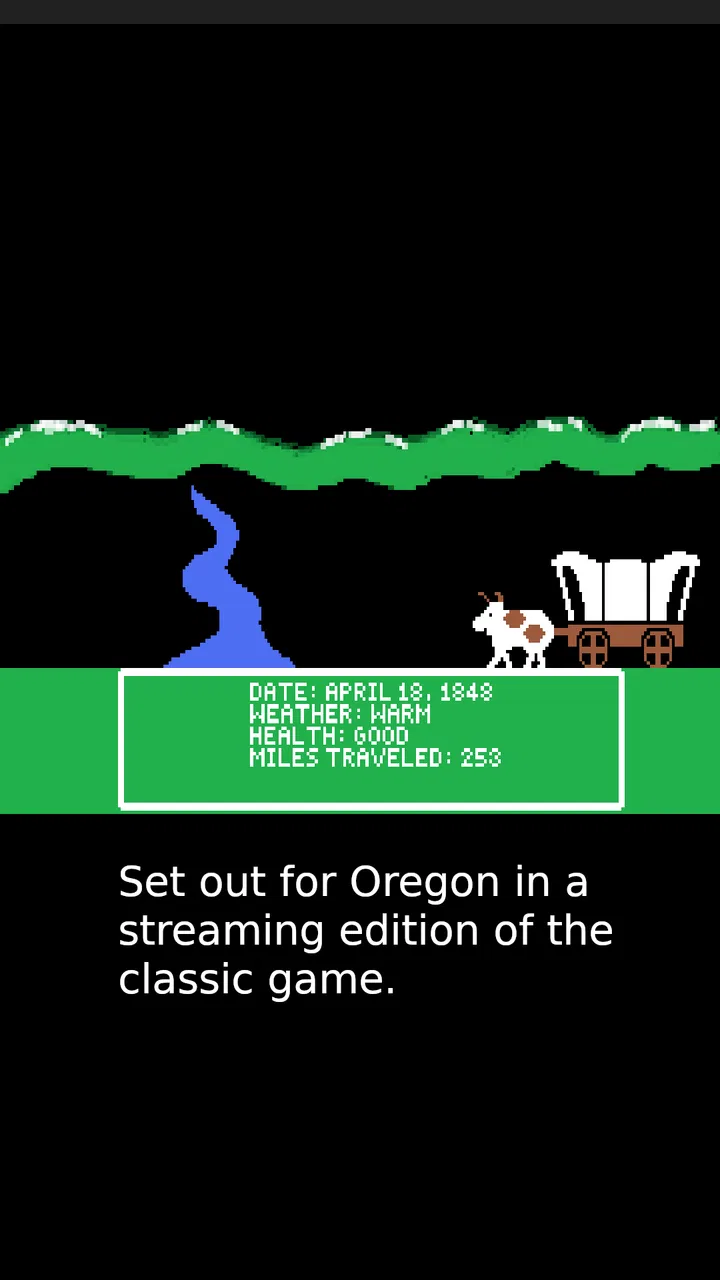
OG Trail - Travel to Oregon
- 4.1
- Rating
- 10.00K
- Installs
- $1.99
- Price

 Analysis by App-foxy
I approached OG Trail expecting a quick trip back to an old educational game, but its appeal is more practical than nostalgia alone. It puts the classic Oregon Trail simulation on Android, where the main attraction is making a series of decisions, watching those decisions shape the journey, and then deciding whether the next attempt can go better. I found that simple structure surprisingly easy to return to because each session feels like a compact experiment rather than a long commitment.
The game comes from UserLAnd Technologies and sits in the educational category. It is rated for Everyone 10+, costs $1.99, and requires Android 6.0 or later. With a 4.1 average from around 700 ratings and over 10K installs, it has attracted a modest but clearly interested audience. The current version is 25.12.05, and the game was released on April 12, 2024.
How the journey turns one decision into another
When I look at how one choice can set up the next, I focus less on finding a perfect answer and more on noticing what information I used at the time. That makes each outcome easier to learn from, even when the journey takes an unexpected turn. The next section considers how to approach a fresh attempt with a clear purpose.
You May Also Like

 AccuWeather: Weather Radar
AccuWeather Review: A Quick, Clear Forecast for Everyday Decisions
For everyday plans, the best forecast is the one you can understand quickly. AccuWeather makes rain timing, radar, and local conditions easy to act on, with a few trade-offs.

 Hill Climb Racing
Why Hill Climb Racing Still Turns Crashes Into One More Run
A tiny car, a bumpy hill and one more upgrade: Hill Climb Racing keeps resurfacing because its simple chaos makes every near-miss feel personal.

 AliExpress - Shopping App
AliExpress Makes Global Shopping Feel Personal, but Shoppers Bear the Risk
AliExpress turns a global marketplace into a pocket-sized discovery engine. Its reach is useful, its shopping loop compelling, and its trade-offs easy to miss.

 Lords Mobile: Kingdom Wars
Lords Mobile Is a Kingdom-Building Routine, Not a Quick Match
A case-by-case verdict on the building, battles, device demands, and social commitments that make Lords Mobile rewarding for some players and exhausting for others.

 PDF Scanner app - TapScanner
TapScanner Makes Paperwork Easier to Capture, Check, and Share
TapScanner makes scanning with a phone feel less like a rescue operation and more like a dependable step in getting work done. Its capture tools are useful, though not flawless.

 Block Blast!
 Shows How Much a Puzzle Game Can Leave Out
A quiet grid game shows why puzzle players increasingly value instant clarity, repeatable skill and low-pressure play—and where the genre still needs to catch up.
More From Our News Desk
View All News


The first action is choosing how to begin
The most important thing to understand is that this is not a conventional action game. I am not controlling a character through fast levels or collecting upgrades in the usual mobile-game sense. The first meaningful action is committing to a journey and accepting that the route will be shaped by decisions, preparation, and changing circumstances. That makes the opening feel more like setting up a small historical survival exercise than starting an arcade challenge.
That distinction matters when you decide whether this game is for you. If you want immediate movement, bright rewards, or a clear sequence of missions, the experience may feel slow. If you enjoy asking “What should I do next?” and then living with the result, the format becomes much more engaging. I liked that the game gives my choices weight without requiring complicated controls.
On a phone, this kind of interaction works best when I have a few quiet minutes rather than when I am looking for something to fill every second. A short break, a train ride, or an evening when I want a thoughtful game fits it well. The game’s value comes from the chain of decisions, not from constant tapping.
Feedback arrives through consequences, not fireworks
The feedback rhythm is the heart of the experience. I make a choice, the journey responds, and that response changes the situation I face next. Instead of treating every action as an isolated button press, the game encourages me to connect cause and effect. A decision that seems sensible at one point can create a harder problem later, while a cautious choice can preserve options for the next stage.
I found this rhythm more interesting than a simple right-or-wrong quiz. The game is educational because it makes planning feel concrete. Resources, timing, risk, and uncertainty become part of the lesson through play. I am not just reading about travel across the American frontier; I am trying to manage a difficult trip and learning why apparently small choices matter.
That also creates a useful family or classroom conversation, provided an adult is willing to play alongside younger users. The Everyone 10+ rating gives a reasonable sense of its broad accessibility, but younger players may still benefit from discussing the historical context and the reasons behind their choices. The game can start those conversations without turning every moment into a lecture.
The reward is understanding what went wrong
The strongest reward is not a pile of virtual currency or a cosmetic prize. It is the feeling that I understand the journey a little better after each attempt. When a run goes badly, I can look back at the decisions that led there and form a new plan. That makes failure useful rather than merely frustrating.
This is where the game differs from many educational apps that deliver information in small quizzes. A quiz can tell me whether I selected the expected answer. This simulation lets me see how several reasonable choices interact over time. The reward is a clearer mental model: prepare more carefully, avoid unnecessary risk, and pay attention to the condition of the journey instead of focusing only on immediate progress.
One practical way to get more from it is to treat each session as a test of one idea. On one attempt, I might play conservatively and observe how that affects the trip. On another, I might accept more risk and compare the outcome. This turns replaying into a deliberate learning method instead of repeating the same choices and hoping for a different result.
The best reward is the lesson hidden inside the outcome. That may sound modest compared with modern mobile games, but it is exactly why the experience can stay interesting after the novelty of the setting wears off.
Why another session begins after the reset
Every failed or completed journey creates a natural reset point. I am not simply restarting a level to chase a higher score; I am returning with a different understanding of the system. That reset is the reason another session begins. I want to see whether a change in planning can produce a better result, or whether the problem was less obvious than I first thought.
This loop is particularly effective for people who enjoy learning through trial and error. It also makes the game easy to share. I can explain a poor outcome to someone else, compare approaches, and start again without needing to remember a complicated control scheme. The reset is clean enough for a new player to understand, yet meaningful enough that experienced players can keep refining their decisions.
There is a trade-off, though. Players who need a strong sense of permanent progression may find the reset less satisfying. The appeal is in improving judgment, not necessarily in building a powerful long-term profile. If you prefer games where every session unlocks new abilities or steadily expands a collection, this particular loop may feel too restrained.
Using it as a learning tool rather than background entertainment
I would not use this as a passive game while watching television. The decisions deserve attention, and the educational value is easy to lose if I rush through them. A better routine is to play one journey with a specific question in mind, then pause afterward and think about the turning points. Even a brief note about what I chose and why can make the next attempt more revealing.
For parents, the game offers a useful way to introduce historical decision-making without handing a child a textbook first. I would encourage asking questions such as why a choice seemed safe, what information was available at the time, and whether the outcome was caused by bad luck, poor preparation, or both. Those questions make the simulation more valuable than simply trying to “win.”
For teachers or informal learning groups, it works best as a discussion starter rather than a complete history course. The game can make travel, planning, and risk easier to talk about, but it should be paired with broader context if the goal is serious historical study. Its strength is giving abstract ideas a playable shape.
Where the mobile format helps and where it gets in the way
Putting this classic simulation on Android makes it convenient. I can start a journey without setting up a computer, and the compact format suits short sessions. The $1.99 price also makes it a straightforward purchase for someone specifically looking for this experience rather than a free game filled with unrelated distractions.
At the same time, a phone screen can make a thoughtful simulation feel less spacious than it would on a larger display. I prefer taking my time with decisions instead of rushing because the interface is designed for quick mobile access. The game is portable, but portability does not automatically make it ideal for every situation. A tablet or a larger-screen Android device would likely be more comfortable for players who want to study each part of the journey closely.
Another limitation is the deliberately focused design. OG Trail is built around one recognizable simulation concept, so it should not be mistaken for a broad educational suite. It will not replace a general history app, a geography reference, or a modern strategy game with extensive systems. Its value comes from doing one thing clearly: letting me experience the logic of the Oregon Trail journey through repeated decisions.
How it compares with usual alternatives
Compared with a standard educational quiz, this game offers more context and less instant certainty. A quiz rewards identifying an answer; this simulation rewards thinking ahead. That makes it better for players who remember ideas through consequences, although a quiz may be more efficient for quick revision.
Compared with a modern survival game, it is less focused on reflexes, crafting, exploration, and spectacle. Those games may offer deeper moment-to-moment control, while this one asks me to manage a journey at a broader level. If I want cinematic presentation or a large world to roam through, I would choose a different genre. If I want a compact decision-making exercise with historical flavor, this is the more suitable option.
Compared with playing the classic experience on a computer, the Android edition’s main advantage is access. I can use it in the same places where I normally play other mobile games. The compromise is that the phone format may feel less immersive for someone who associates the original with a larger screen and a slower, more deliberate setup.
A realistic everyday session
Imagine having fifteen quiet minutes before an appointment. I can begin a journey, make a few important choices, and reach a point where the consequences are clear enough to think about. If the trip starts going badly, I do not need to force myself through a long campaign. I can treat the outcome as feedback, close the game, and return later with a revised plan.
That is a better use case than opening it when I want a rapid burst of entertainment. The game asks for curiosity and patience. It rewards me when I notice patterns, not when I tap fastest. I also think it works well for two people sharing one device: one person can propose a decision, the other can challenge it, and the result becomes a small discussion about risk and preparation.
For a child using it independently, I would set expectations clearly. The goal is not simply to avoid every setback, because some uncertainty is part of the experience. The useful question is whether the player can explain the reasoning behind the next attempt. That turns the reset into learning instead of disappointment.
Who should choose it and who should skip it
I recommend it to people who enjoy historical settings, management decisions, and replaying a situation to improve their judgment. It is also a good fit for families seeking an educational game that does not feel like a worksheet. Players who already like simulations may appreciate how quickly it gets to the central decision loop.
I would skip it if your priority is fast action, deep character customization, competitive multiplayer, or a large stream of new content. I would also look elsewhere if you want a structured course with explanations, tests, and progress tracking. This game teaches through experience, and that approach is not equally effective for everyone.
The age rating makes it approachable for a broad audience, but the best experience still depends on maturity and interest. Someone can be old enough to play it and still find the pace unappealing. Conversely, a younger player who enjoys strategy and discussion may get more from it than an older player expecting a conventional adventure game.
My verdict on the complete action-feedback-reward loop
OG Trail succeeds because its loop is easy to understand but difficult to exhaust immediately: I make a decision, receive a consequence, learn from the result, reset the journey, and begin again with a better question in mind. That structure gives the game its educational purpose without making it feel like a lecture.
The experience is not flashy, and it does not try to compete with large modern survival games. Its limitations are closely tied to its strengths: the focused design may feel narrow, the pace may feel calm, and the reset-based progression may not satisfy players who want permanent rewards. For the right audience, those are acceptable trade-offs.
After spending time with it, I see the $1.99 purchase as most worthwhile for someone who specifically wants a playable Oregon Trail simulation on Android. I would recommend it to a friend who enjoys thoughtful choices and does not mind learning through failure. The reason I would suggest it is not just that it recreates a classic idea, but that it makes each new attempt feel like a chance to understand the journey more intelligently.
In short, OG Trail is a compact educational game for patient players. Its strongest moment comes after an outcome, when I can identify the decision that changed the journey and immediately imagine a better approach. That is the point where another session becomes tempting, and it is also the clearest sign that the game’s simple loop is doing its job.
FAQs for OG Trail - Travel to Oregon
01What is OG Trail - Travel to Oregon?
OG Trail - Travel to Oregon is a journey and survival-style game inspired by classic trail adventures. Players guide a group of travelers toward Oregon while managing supplies, health, transportation, and unexpected events along the route. The experience combines planning, exploration, and decision-making, making each trip feel different depending on the choices you make and the risks you are willing to take.
02How do you play OG Trail - Travel to Oregon?
Gameplay focuses on preparing for and completing a long overland journey. You typically need to manage resources such as food, equipment, money, and transportation while choosing how to respond to problems on the trail. Weather, accidents, illnesses, and other events can change your plans, so successful runs require careful decisions rather than simply moving forward as quickly as possible.
03Is OG Trail - Travel to Oregon suitable for children?
The game can be appropriate for older children and families, especially for players who enjoy educational history, strategy, and adventure themes. However, some situations may involve illness, danger, loss, or difficult survival choices. Parents should review the current age rating and store description before downloading, since content ratings and advertising policies may vary between the Android and iOS versions.
04Does OG Trail - Travel to Oregon require an internet connection?
Many trail-management and single-player activities may be playable without a constant internet connection, which is useful when traveling. However, certain features can depend on connectivity, including advertisements, analytics, updates, cloud services, or in-app purchases. Because requirements may change with new versions, it is best to launch the game once online and check whether all desired features remain available offline.
05Is OG Trail - Travel to Oregon free to download?
The app may be offered as a free download, but availability of advertisements, optional purchases, or premium features can depend on the platform and region. Before installing, check the official Google Play or App Store listing for the current pricing details, permissions, and purchase information. Reviewing these details is especially important if children will be using the device.
Pros
- Offline access helps when traveling through areas with weak mobile coverage.
- Trip planning feels focused on Oregon’s roads
- trails
- and outdoor destinations.
- Useful for discovering lesser-known stops beyond the major tourist attractions.
- The outdoor-focused design suits hikers
- campers
- and road-trip travelers.
- Location-based information can make spontaneous detours easier to plan.
Cons
- Coverage may be less useful for travelers visiting outside Oregon.
- Some listings may have limited details
- photos
- or recent user updates.
- Outdoor routes can require extra verification for closures and seasonal access.
- Battery and GPS use may increase during extended navigation sessions.
- The app may feel too specialized for users seeking a general travel guide.

OG Trail - Travel to Oregon
Gallery